


Industrial coating failure is usually caused by poor surface preparation, incorrect coating selection, improper application, or excessive mechanical and thermal stress. These issues can be prevented through proper surface cleaning, choosing the right coating system, controlling thickness and curing, and carrying out regular inspections.
Introduction
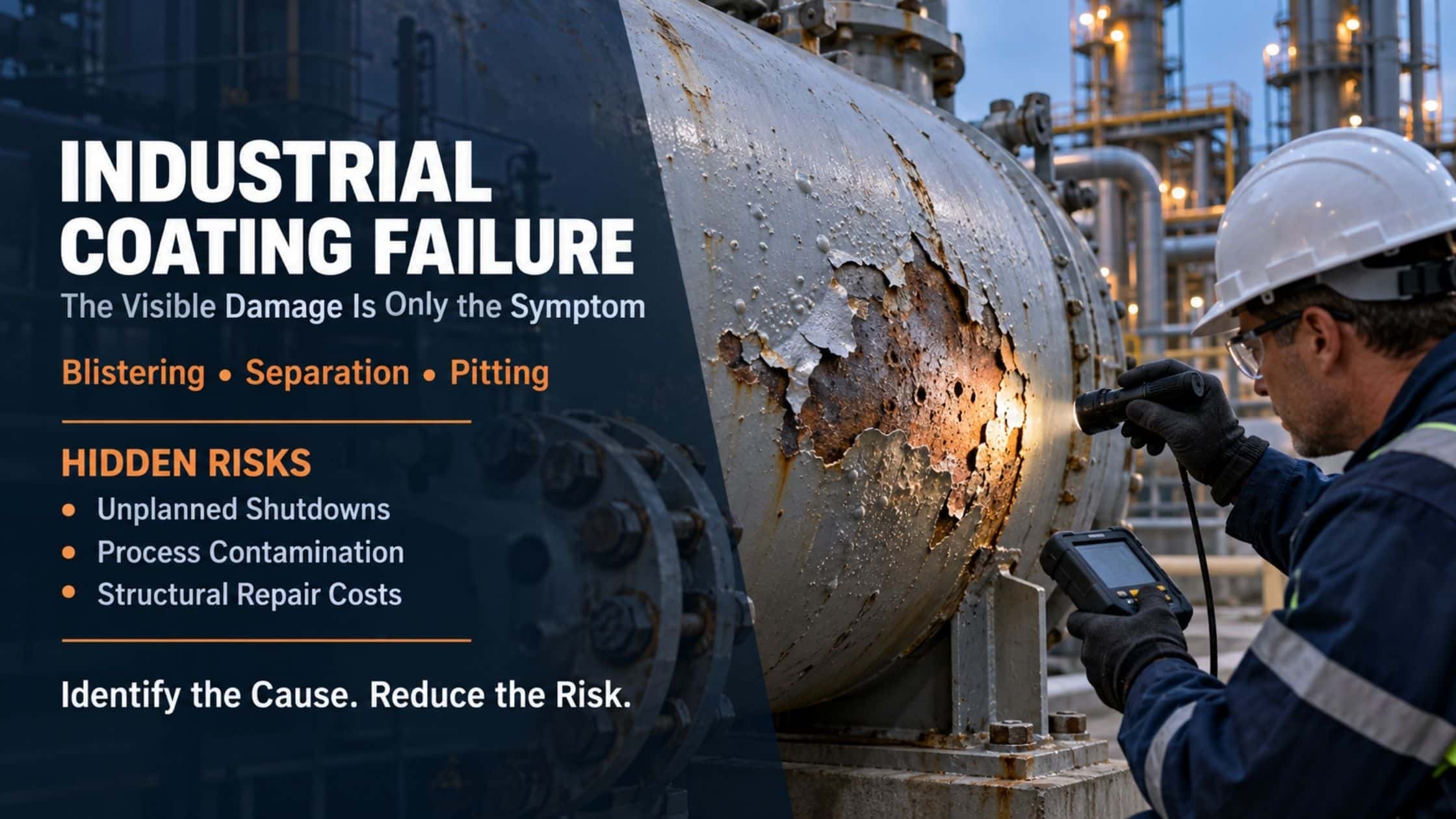
Coating failure is a symptom, not the root event. By the time blistering, coating separation, or pitting is visible, the asset has usually been running unprotected for weeks or months. On a heat exchanger, storage tank, or pressure vessel, that gap is where unplanned shutdowns, contamination incidents, and structural repair costs originate.
The following are common causes of industrial coating failure across power plants, process facilities, and industrial equipment, along with practical controls for reducing failure risk.
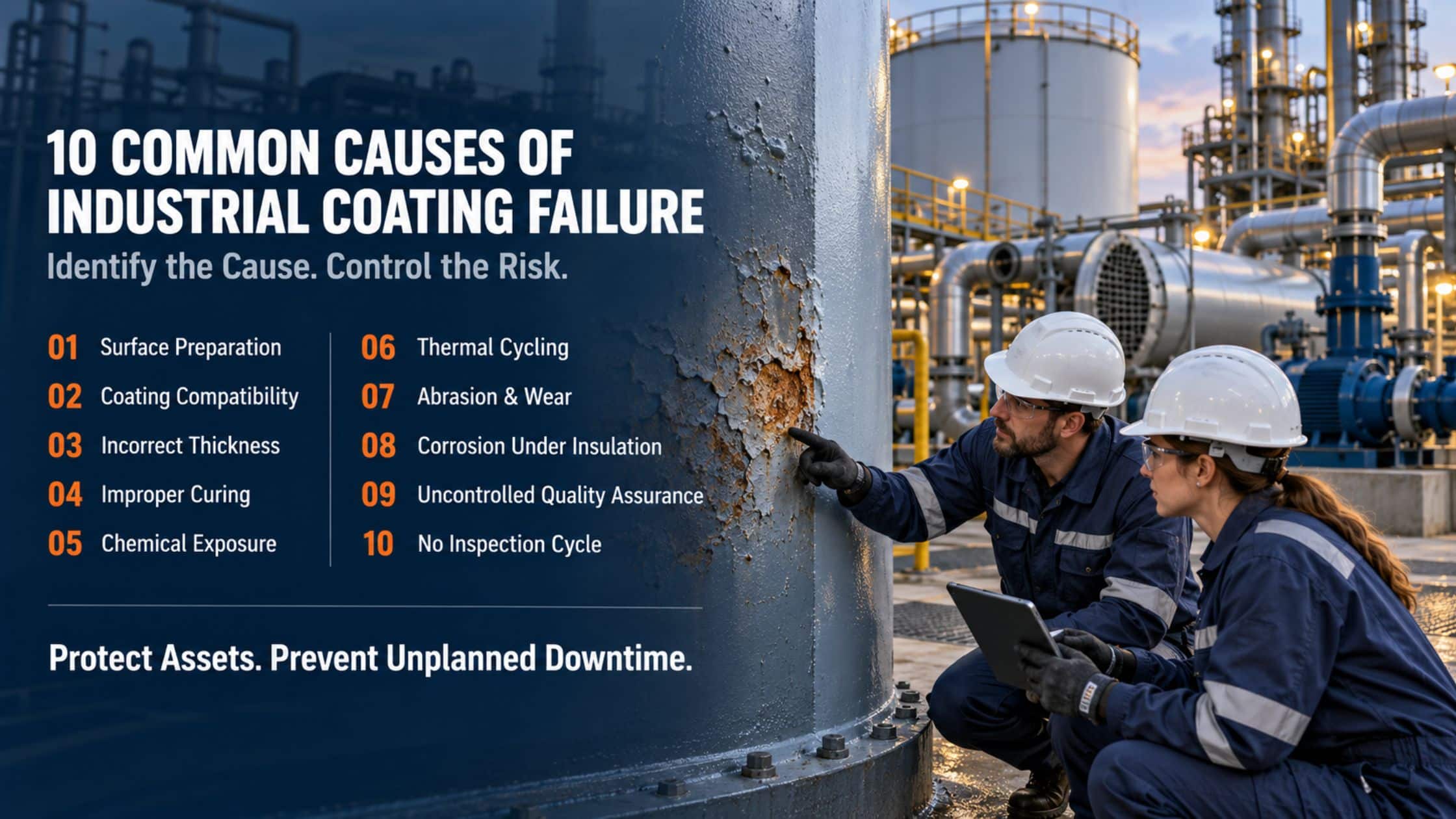
1. Poor Surface Preparation and Contamination
A coating needs a clean and properly prepared surface to stick well. Rust, old paint, oil, dust, or salt left on the surface can weaken adhesion and cause the coating to fail early. AMPP surface preparation standards provide guidance for achieving and checking the required surface condition before coating application.
Controls:
- Clean and prepare the surface according to the coating manufacturer’s requirements before application.
- Check the surface roughness to make sure the coating can bond properly.
- Test for surface salts, especially when the equipment will be exposed to water, chemicals, or high humidity.
- Make sure the surface is clean, dry, and free from contaminants before applying the coating.
2. Coating Chemistry Mismatched to Service Conditions
Not every coating is suitable for every industrial environment. A coating designed for outdoor exposure may not perform well when continuously exposed to water, chemicals, or high temperatures. Choosing a coating only because it is an “epoxy” is not enough; its performance should match the actual working conditions.
Controls:
- Cross-check the manufacturer’s technical data sheet against actual service temperature range, chemical exposure (including cleaning chemicals and upset conditions), and immersion vs. atmospheric duty — not the nameplate operating condition alone.
- For demanding applications such as FGD systems, coal mills, chemical tanks, and pipeline interiors, Duromar® 100% solids, zero-VOC epoxy systems are designed to provide durable protection under harsh operating conditions.
- Re-verify compatibility whenever a process change alters feedstock, cleaning chemicals, or operating temperature.
3. Applying the Coating at the Wrong Thickness
Coatings perform within a defined dry film thickness (DFT) range. Under-thickness leaves inadequate barrier protection; over-thickness traps solvent and causes cracking or a cure that never completes.
Controls:
- Check the wet film thickness during application and measure the final dry film thickness (DFT) using a calibrated gauge.
- Follow the manufacturer’s recommended number of coats and thickness for each coat.
- Do not assume that one very thick coat will provide the same performance as several properly applied coats.
- For critical or high-value equipment, use trained and qualified coating applicators.
4. Improper Curing Conditions
A coating needs the right temperature, humidity, and curing time to develop its full strength and chemical resistance. If it is applied or allowed to cure under unsuitable conditions, it may look dry but still be weak and more likely to fail after the equipment returns to service.
Controls:
- Monitor the air temperature, surface temperature, and humidity during application and curing.
- Make sure the surface temperature is safely above the dew point to prevent moisture from forming on the surface.
- Avoid exposing a partially cured coating to chemicals, water, heat, or heavy use.
5. Chemical Incompatibility with Process Media
Industrial coatings can be damaged when they are exposed to chemicals they are not designed to withstand. Acids, alkalis, solvents, and other aggressive chemicals can cause softening, blistering, cracking, or loss of adhesion over time.
Controls:
- Identify all chemicals the coating may come into contact with, including cleaning chemicals and occasional chemical spills.
- Choose a coating system that is designed for the specific chemical, concentration, temperature, and exposure conditions.
- For demanding chemical or immersion applications, use specialized lining systems recommended by the coating manufacturer.
- Review the coating’s chemical compatibility whenever the process, chemicals, or operating temperature changes.
6. Thermal Cycling Beyond the Coating’s Rated Range
Repeated heating and cooling can cause a coating and the underlying surface to expand and contract at different rates. Over time, this can lead to cracking, peeling, or loss of adhesion. This is particularly important for heat exchangers, condensers, pipelines, boilers, and other equipment exposed to frequent temperature changes.
Controls:
- Choose a coating suitable for the equipment’s full temperature range.
- Use flexible or high-temperature coatings for frequent temperature changes.
- Inspect regularly for cracks, peeling, or coating damage.
- Monitor equipment with frequent heating and cooling cycles.
7. Mechanical Abrasion and Wear
Constant contact with particles, slurry, equipment, or maintenance activities can gradually wear away a coating. Once the coating becomes thin or damaged, the underlying metal can be exposed to corrosion.
Controls:
- Specify filled or reinforced epoxy systems for known high-wear zones — slurry lines, chutes, impellers.
- Add sacrificial wear layers or ceramic-filled topcoats where mechanical stress is concentrated rather than uniform.
- Brief maintenance crews on coated-surface contact points before routine work, since incidental mechanical damage during unrelated maintenance is a frequent, undocumented failure source.
8. Corrosion Under Insulation (CUI)
Insulated piping and vessels trap moisture against the coated surface, creating a sustained wet environment that atmospheric-rated coatings were never designed to hold back. CUI is largely invisible until insulation is removed — external inspection alone will not catch it.
Controls:
- Specify CUI-rated coating systems on insulated assets operating in the 10°C–175°C range, where CUI risk peaks.
- Seal insulation jacketing to control water ingress at the source.
- Build insulation removal and substrate inspection into turnaround planning for critical lines.
9. Uncontrolled Quality Assurance During Application
Root-cause analysis on failed coatings points back to application records more often than material defects: unverified surface prep, unmeasured thickness, or coating applied outside acceptable weather windows, with no documentation to catch it at the time.
Controls:
- Run a documented QA plan covering surface prep verification, environmental logging, wet/dry film thickness checks, and holiday (pinhole) testing at defined checkpoints, not just at project close.
- Retain application records — batch numbers, weather logs, thickness data — as the baseline for any future failure investigation.
10. No Structured Inspection or Maintenance Cycle
A correctly specified, correctly applied coating still degrades on a timeline. Without scheduled inspection, a pinhole or early chalking site goes undetected until it’s an active corrosion point.
Controls:
- Set inspection intervals (visual, adhesion, holiday testing) by asset criticality and exposure severity, not a blanket plant-wide schedule.
- Spot-repair minor damage on discovery rather than deferring to the next full turnaround.
- Track coating condition over time so recoating is scheduled proactively, not triggered by failure.
Frequently Asked Questions
1. What is the leading cause of industrial coating failure?
Contaminated or under-prepared substrate. Residual rust, mill scale, or soluble salts prevent proper adhesion regardless of coating quality or application skill.
2. What service life should an industrial coating deliver?
10–20 years when specified, applied, and maintained to standard. Aggressive chemical or thermal environments compress that range; CUI and high-cycle thermal service are the two most common exceptions.
3. Does a coating failure require full removal, or can it be spot-repaired?
Localized failure — isolated blistering, mechanical damage — can be spot-repaired if the surrounding coating passes adhesion testing. Widespread delamination, chalking, or corrosion under the film requires full removal and recoating.
4. How do you distinguish a surface prep failure from a chemical incompatibility failure?
Surface prep failures present as adhesion loss at the bond line, often with visible corrosion beneath the coating. Chemical incompatibility presents as softening, blistering, or discoloration across the exposed surface, concentrated where direct chemical or vapor contact occurs. Cross-hatch adhesion testing at the failure site confirms which mechanism is active.
5. Which asset classes carry the highest coating failure risk?
Heat exchangers, storage tanks, cooling towers, and insulated piping in refineries, power plants, and chemical processing — combined chemical, thermal, and moisture exposure on these assets exceeds general-purpose coating design limits more often than on other equipment classes.
Conclusion
Industrial coating failure can often be prevented through proper surface preparation, coating selection, application, inspection, and regular maintenance. Identifying early signs such as chalking, blistering, peeling, or localized corrosion can help prevent more serious damage and costly repairs.
Arudra Engineers provides industrial coating, lining, inspection, and maintenance solutions for power plants, process industries, and other industrial applications. If your equipment is showing signs of coating deterioration, a professional assessment can help identify the cause and determine the right corrective approach.
Contact Arudra Engineers to discuss your industrial coating and corrosion protection requirements.


