


In power plants, refineries, petrochemical facilities, and process industries, condenser performance directly influences plant efficiency, energy consumption, and equipment reliability. If left untreated, fouling can contribute to reduced output, higher operating costs, and unplanned shutdowns. Selecting the right tube cleaning method is therefore critical. Among the most widely used techniques, bullet cleaning and hydro-jetting remain important options for restoring condenser efficiency.
This guide provides an objective comparison of bullet cleaning versus hydro-jetting for condenser tubes, helping plant engineers determine the most suitable approach based on deposit type, tube condition, outage duration, environmental considerations, and operational goals.
In general, bullet cleaning is well suited to routine maintenance, soft fouling, biological growth, silt, and lighter deposits, while hydro-jetting is generally more effective for severe scale, hard deposits, and partially blocked tubes. Where different types of fouling occur together, a sequential or combined cleaning strategy may provide the most effective result.
Why Effective Condenser Tube Cleaning Matters
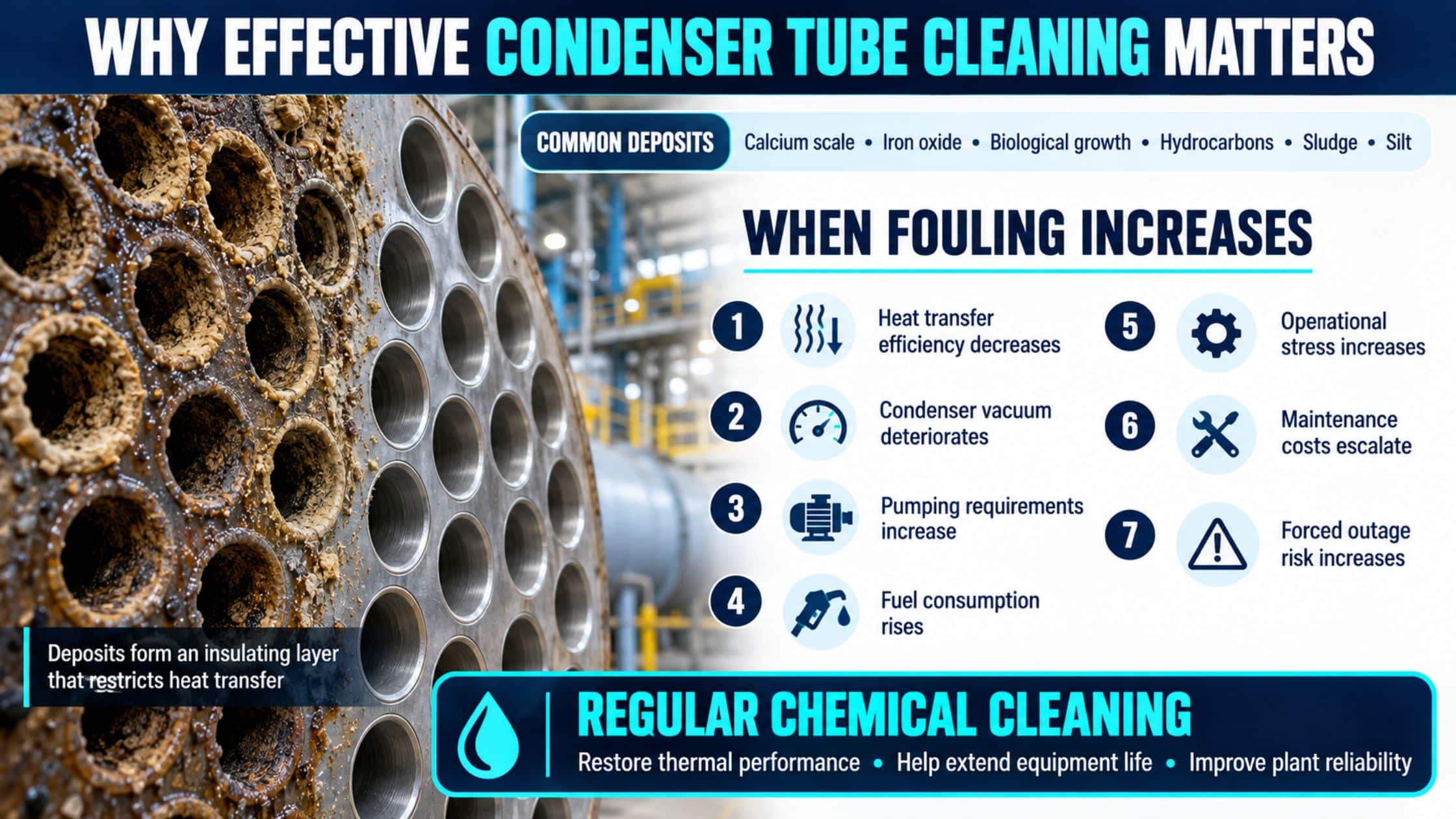
Condenser and heat exchanger tubes gradually accumulate deposits such as calcium scale, iron oxide, biological growth, hydrocarbons, sludge, and silt. These contaminants create an insulating layer that restricts heat transfer. When fouling increases:
- Heat transfer efficiency decreases
- Condenser vacuum performance deteriorates
- Pumping requirements increase
- Fuel consumption rises
- Equipment experiences higher operational stress
- Maintenance costs escalate
- The risk of forced outages increases
Regular chemical cleaning restores thermal performance, helps extend equipment life, and improves overall plant reliability.
What Is Bullet Cleaning for Condenser Tubes?
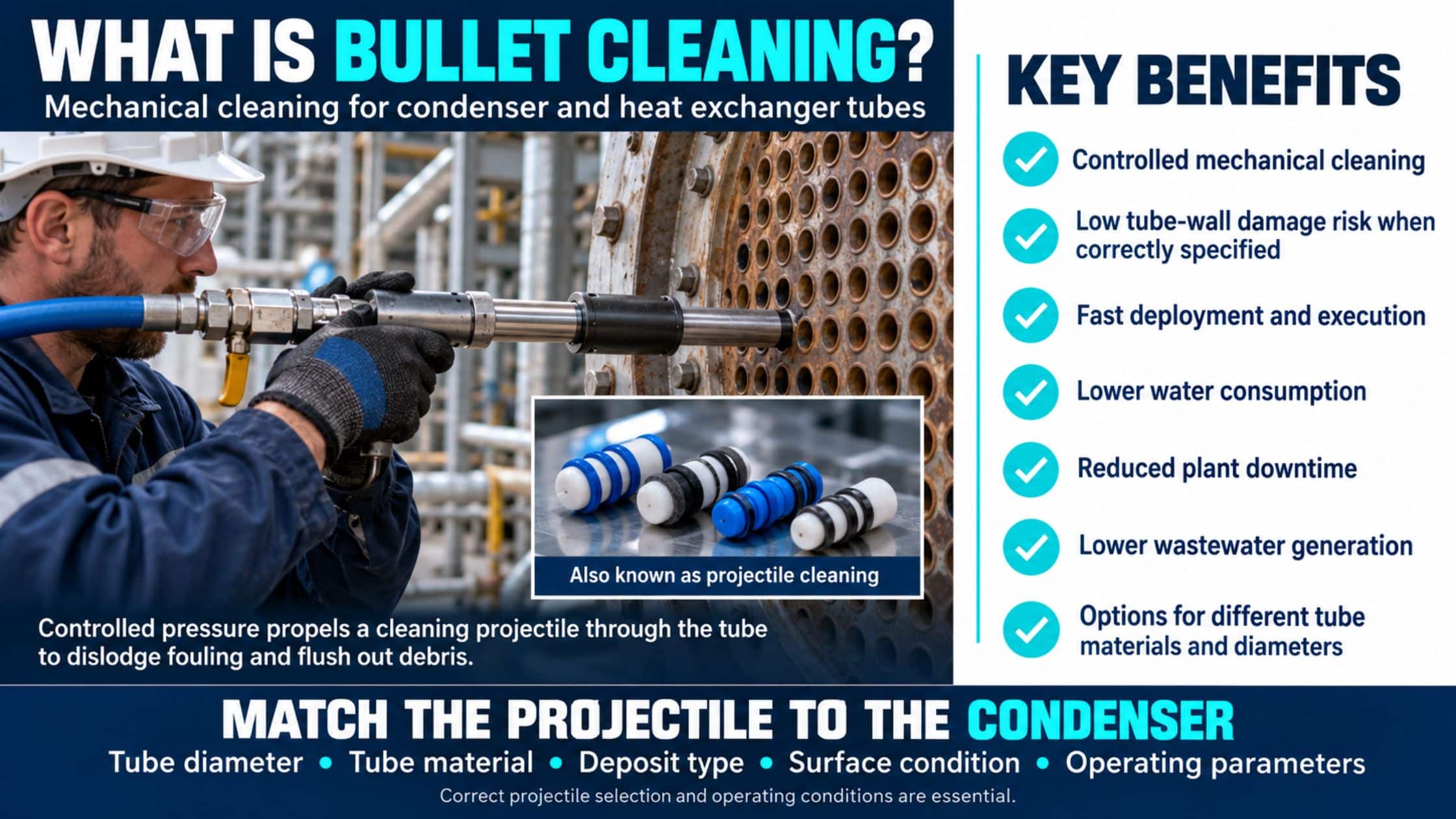
Bullet cleaning (also known as projectile cleaning) is a mechanical process that uses specially designed cleaning projectiles propelled through the tubes by controlled water pressure, air pressure, or fluid flow. As the projectile travels through the tube, it scrapes and dislodges accumulated fouling while flushing debris out of the opposite end.
Benefits of Bullet Cleaning
- Low-risk mechanical cleaning when the appropriate projectile and operating parameters are selected
- Generally low risk of tube-wall damage when correctly specified and operated
- Fast deployment and execution
- Lower water consumption
- Reduced plant downtime
- Lower wastewater generation
- Suitable for multiple tube materials and diameters
This method is particularly valuable for routine maintenance programmes where preserving tube integrity is a priority.
What Is Hydro-Jetting Cleaning?
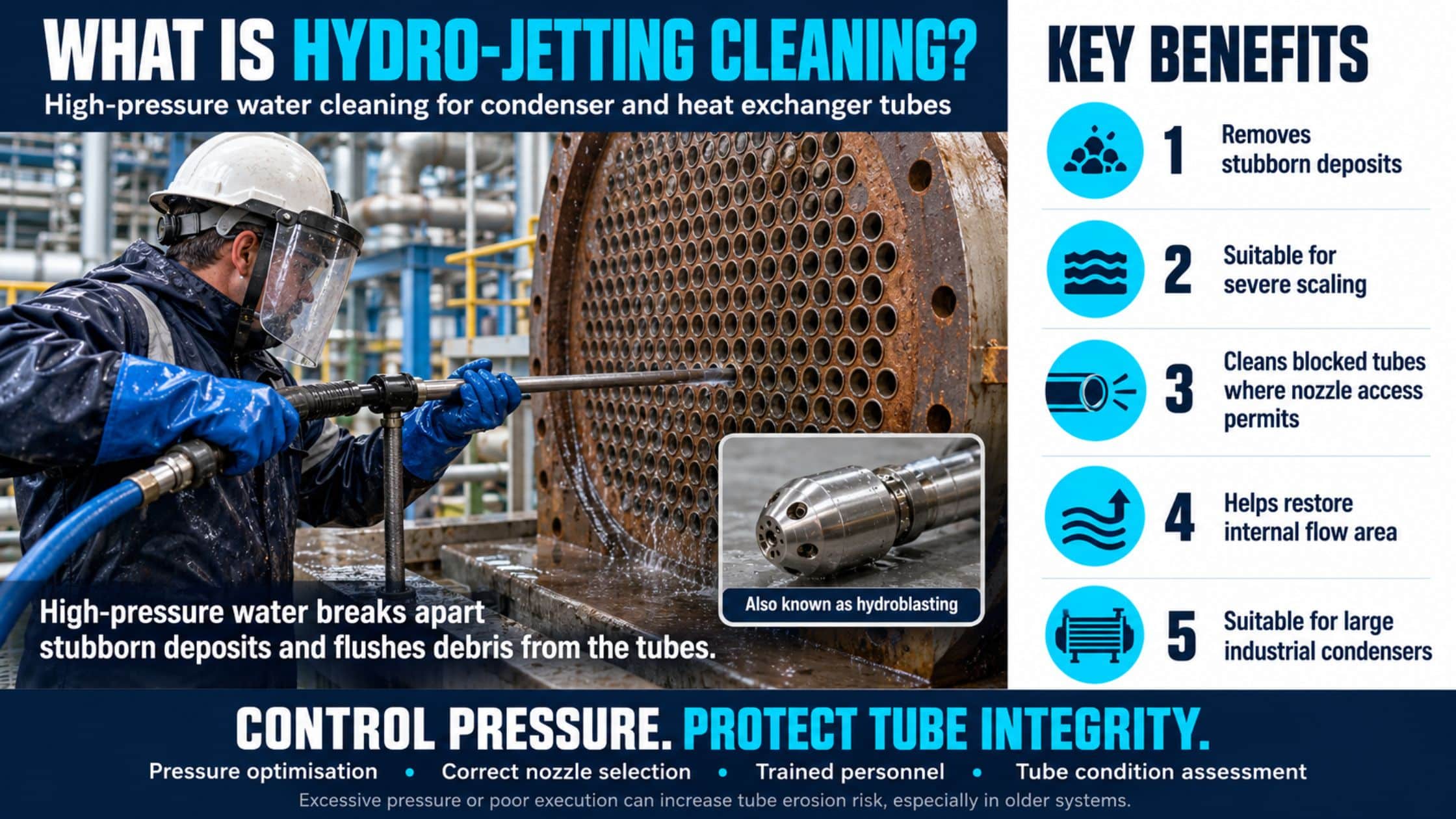
Hydro-jet Cleaning (also known as hydroblasting) uses high-pressure water streams delivered through specialised nozzles to remove fouling, scale, sludge, corrosion products, and other contaminants. The kinetic energy of the water stream breaks apart stubborn deposits and flushes them from the system.
Hydro-jetting is commonly applied where deposits are heavily adhered or difficult to remove by mechanical means alone.
Key Benefits of Hydro-Jetting
- Effective removal of stubborn deposits
- Suitable for severe scaling conditions
- Thorough cleaning of blocked tubes
- Can help restore the internal flow area of fouled tubes
- Compatible with large industrial condensers
However, excessive pressure, improper nozzle selection, or poor execution can increase the risk of tube erosion, particularly in older systems. Modern procedures therefore require pressure optimisation, appropriate nozzle selection, trained personnel, and consideration of tube material and condition.
Bullet Cleaning vs Hydro-Jetting: Detailed Comparison
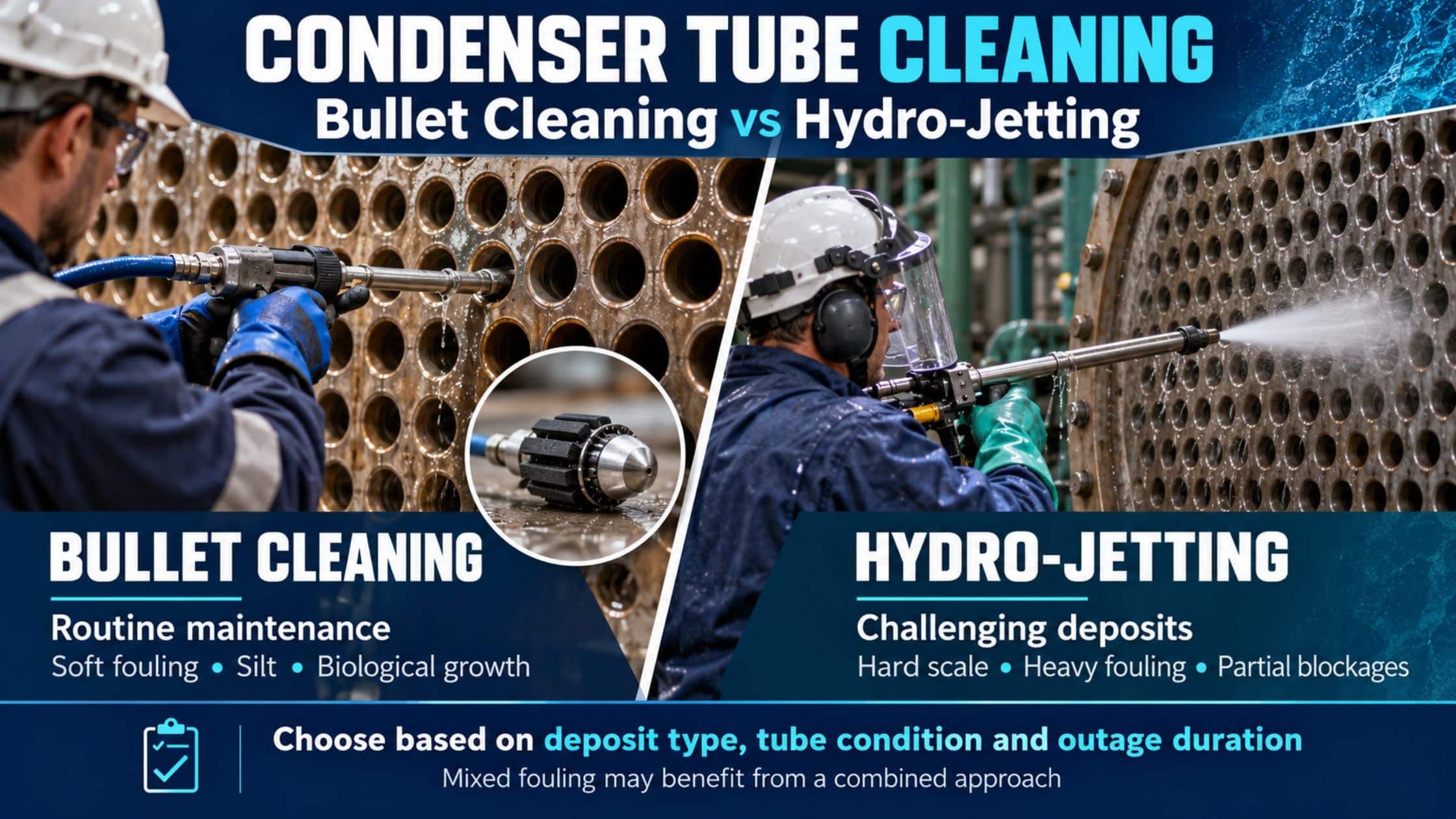
The choice between the two methods should be based on actual operating conditions rather than assuming one technology is always superior.
| Comparison Factor | Bullet Cleaning | Hydro-Jetting |
|---|---|---|
| Cleaning Mechanism | Mechanical projectile cleaning | High-pressure water cleaning |
| Soft Deposit Removal | Excellent | Good |
| Biofouling Removal | Excellent | Good |
| Hard Scale Removal | Moderate to Good | Excellent |
| Heavy Mineral Deposits | Limited in severe cases | Highly effective |
| Tube Safety | Generally low risk when correctly specified | Depends on pressure, nozzle selection, tube material, and tube condition |
| Water Consumption | Low | High |
| Downtime Requirement | Low | Moderate |
| Wastewater Generation | Minimal | Higher |
| Environmental Impact | Lower water and wastewater requirements | Higher water and wastewater requirements |
| Operating Cost | Often lower for routine cleaning, depending on site conditions | Depends on deposit severity, equipment, labour, and wastewater requirements |
| Risk of Tube Damage | Generally low when correctly specified and operated | Can increase if pressure or nozzle parameters are unsuitable |
| Best Application | Routine maintenance and soft fouling | Severe scaling and stubborn deposits |
The most suitable method depends on the deposit characteristics, tube metallurgy, tube-wall condition, accessibility, outage window, water availability, and required cleaning depth.
Which Method Works Best for Different Fouling Conditions?
1. Soft Fouling and Biological Growth
Examples: algae, biological slime, silt, mud, loose corrosion products.
Bullet cleaning typically delivers excellent results while minimising water use and downtime.
It is particularly useful where deposits can be mechanically dislodged without requiring the higher energy associated with high-pressure water cleaning.
2. Hard Scale and Mineral Deposits
Examples: calcium carbonate scale, silica deposits, hard crystallised fouling.
Hydro-Jet Cleaning service is generally preferred because the high-pressure water stream can break apart deposits that resist projectile cleaning.
The required pressure and nozzle configuration should be selected according to the deposit type and tube condition rather than simply using the highest available pressure.
3. Mixed Fouling Conditions
Many condensers experience a combination of biofouling, corrosion products, and mineral scale. In these cases, a sequential or combined approach is often the most effective solution.
For example, one cleaning method may be used to address softer or loosely attached deposits, followed by a more intensive method for harder residual scale. The actual sequence should be determined from the deposit condition and equipment requirements.
Safety Considerations and Tube Protection
Tube condition should be treated as a primary selection factor, not simply a secondary safety consideration.
Bullet cleaning relies primarily on mechanical projectile action and, when the appropriate projectile and operating parameters are selected, can minimise the risk of tube-wall damage.
Hydro-jetting, while highly effective, requires strict operational controls. Proper nozzle selection, trained personnel, and pressure optimisation are essential to minimise the risk of tube damage, especially in aged systems.
Before cleaning, maintenance teams should consider tube metallurgy, wall condition, previous cleaning history, known areas of thinning, and the nature of the deposits. These factors help determine the appropriate cleaning intensity and method.
Water Consumption, Waste Generation, and Environmental Impact
Bullet Cleaning
Bullet cleaning offers specific environmental advantages associated with lower water consumption, reduced wastewater generation, and minimal secondary waste.
Hydro-Jetting
Hydro-jetting typically requires higher water volumes and more extensive wastewater handling. For facilities operating under strict environmental regulations, these factors can influence the final selection.
Water consumption and wastewater management should therefore be considered alongside cleaning effectiveness, outage duration, labour requirements, and site-specific environmental controls.
Decision Guide for Plant Engineers
| Plant Condition | Recommended Approach |
|---|---|
| Routine preventive maintenance | Bullet Cleaning |
| Biological fouling | Bullet Cleaning |
| Silt and mud accumulation | Bullet Cleaning |
| Light-to-moderate scale | Bullet Cleaning or Hydro-Jetting |
| Severe mineral scale | Hydro-Jetting |
| Hard crystallised deposits | Hydro-Jetting |
| Partially blocked tubes | Hydro-Jetting |
| Mixed fouling conditions | Combined Cleaning Strategy |
| Water conservation priority | Bullet Cleaning |
| Deep restoration requirement | Hydro-Jetting |
Where the condition of the tubes is uncertain, a pre-cleaning assessment can help determine the appropriate cleaning intensity and reduce the risk of applying an unsuitable method.
Key Takeaways
- Bullet cleaning is highly suitable for routine maintenance, soft deposits, biological fouling, and light-scale accumulation. It can offer lower water consumption, shorter outages, and a generally low risk of tube damage when the method is correctly specified and operated.
- Hydro-jetting is particularly effective for hard mineral scale, crystallised deposits, and severe fouling that may not respond to mechanical methods alone.
- Hydro-jetting performance and tube protection depend on appropriate pressure, nozzle selection, tube material, tube condition, and operator control.
- In mixed fouling situations, a combined strategy often delivers the best overall result.
- There is no universally superior condenser tube cleaning method; the correct choice depends on the actual fouling and equipment condition.
Final Words
Choosing between bullet cleaning and hydro-jetting requires careful evaluation of fouling type, deposit severity, maintenance goals, water resources, environmental constraints, and shutdown schedules. There is no universal solution—each method offers distinct advantages under specific conditions.
Bullet cleaning is generally well suited to routine maintenance and softer deposits, while hydro-jetting provides greater cleaning capability for severe scale and stubborn deposits. In mixed conditions, combining cleaning techniques may provide a more effective overall solution.
A thorough technical assessment of the actual deposits and equipment condition remains the most reliable way to select the most effective and cost-efficient cleaning approach.
Looking for the right cleaning strategy for your condenser or heat exchanger tubes? Connect with Arudra Engineers today for a customized cleaning solution that maximizes efficiency.


