


Chimney stack corrosion can become a costly reliability problem when acidic condensation, moisture and thermal cycling combine inside flue-gas systems. As hot flue gases cool toward their dew point, sulfur- and chlorine-containing contaminants can contribute to the formation of corrosive acids.
For power plants and process facilities, such degradation can translate into unplanned maintenance, inspection requirements and expensive shutdowns. Glass flake epoxy linings address this problem by combining an epoxy barrier matrix with thin, overlapping glass flakes.
Why Chimney Stacks Experience Dew-Point Corrosion
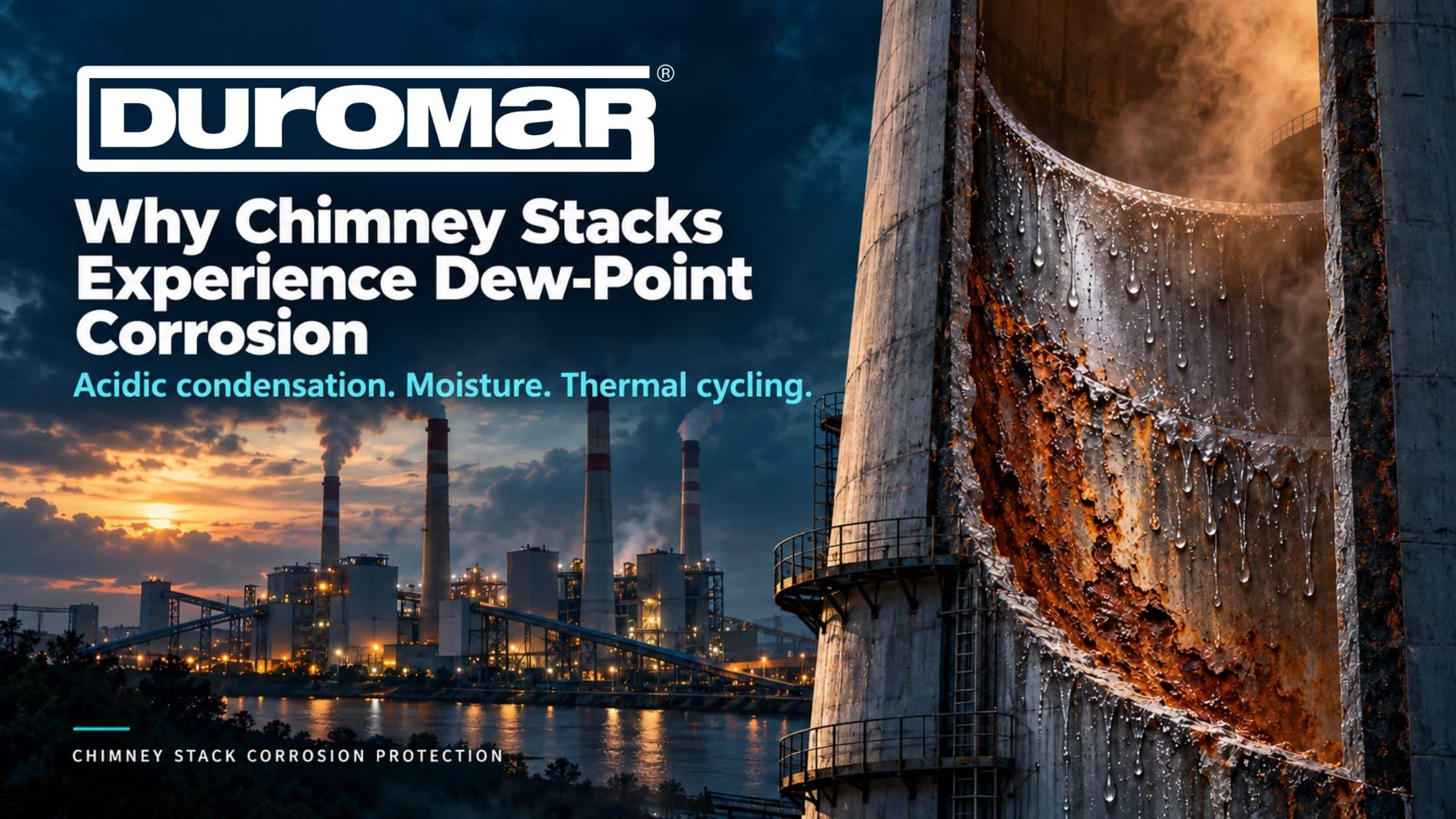
Flue gases contain moisture and combustion-derived contaminants. Depending on fuel composition and operating conditions, sulfur and chlorine compounds can contribute to acidic condensate formation as the gas temperature falls.
When internal surfaces approach conditions at which condensation occurs, acidic moisture can accumulate on the lining or exposed substrate. This creates a combination of:
- Acidic chemical exposure
- Continuous or intermittent moisture
- Temperature fluctuations
- Thermal expansion and contraction
- Long-duration contact with contaminants
- Localised corrosion at vulnerable areas
This is why chimney stack corrosion protection cannot rely only on a coating that provides basic surface coverage. The lining must remain chemically resistant, adherent and sufficiently intact under the actual service conditions.
How Permeation Allows Corrosion to Reach the Substrate
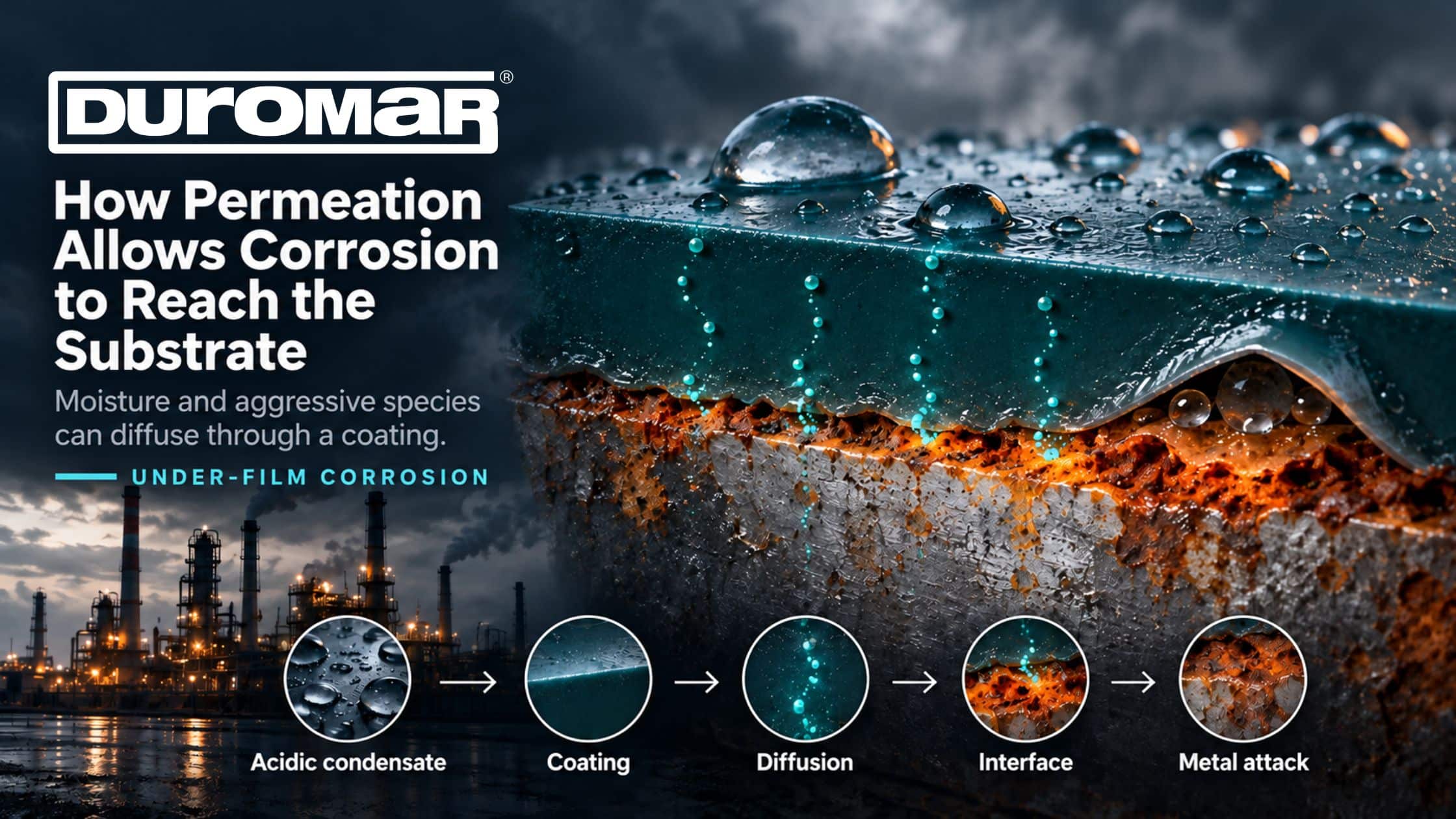
A conventional organic coating creates a barrier between the corrosive environment and the metal substrate. However, the polymer film is not necessarily an absolute barrier at a molecular level. Moisture and aggressive chemical species can gradually diffuse through microscopic free volume within the polymer.
The general mechanism can be represented as:
Acidic condensate → coating surface → molecular diffusion → coating/substrate interface → metal attack
Once corrosive species reach the interface, they can initiate corrosion beneath the coating. Progressive corrosion may cause adhesion loss, blistering, under-film corrosion and eventual delamination.
The problem is therefore not simply whether a coating initially covers the steel. The more important engineering question is how effectively the coating slows the transport of moisture and aggressive species throughout its service life.
How Glass Flake Epoxy Linings Create a Tortuous Barrier
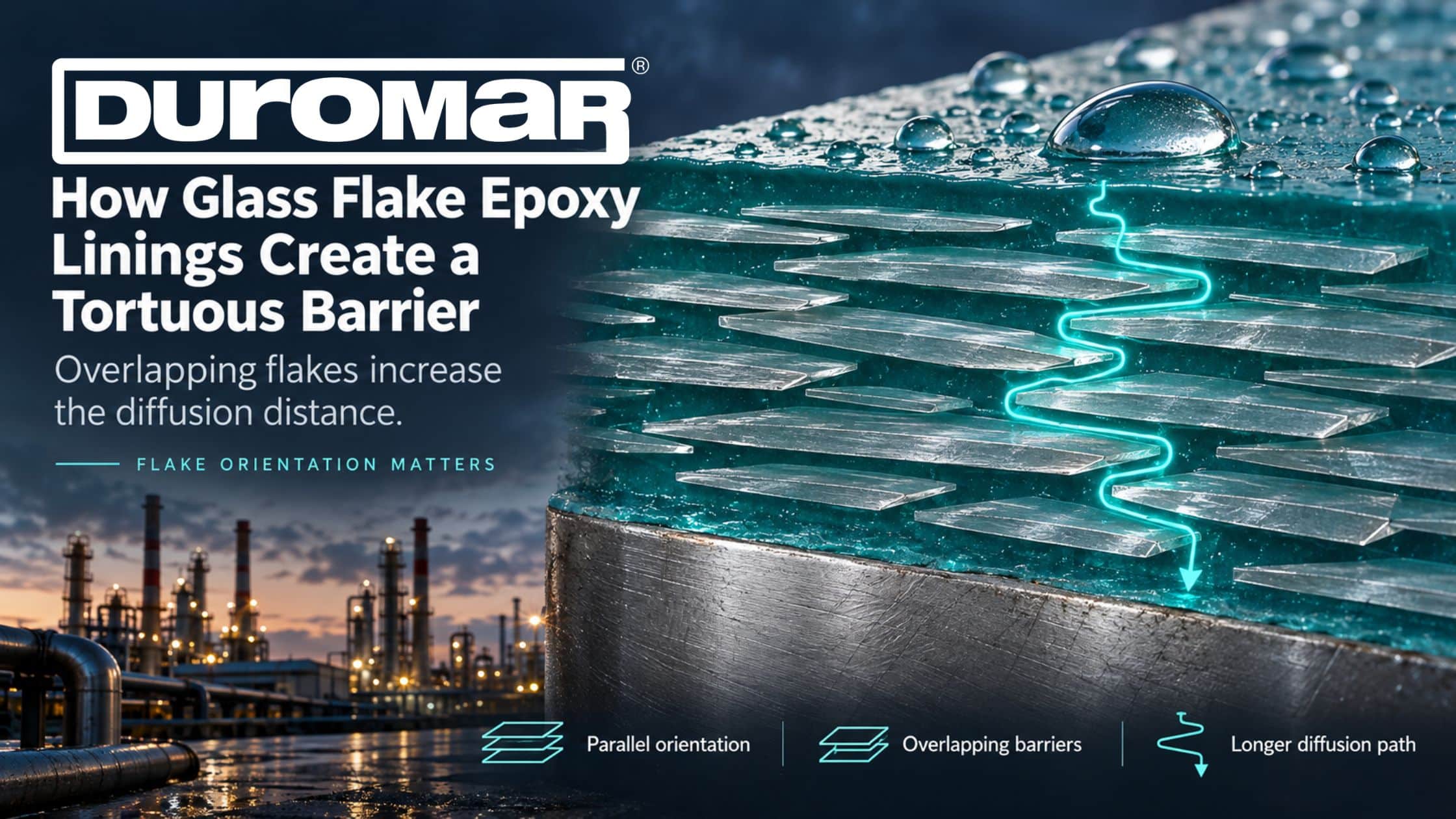
Glass flakes are thin, plate-like particles incorporated into the epoxy matrix. When properly dispersed and oriented within the cured film, these flakes interrupt the otherwise relatively direct pathway through the polymer.
Instead of allowing a diffusing molecule to move approximately straight toward the substrate, overlapping flakes force the molecule to travel around successive impermeable barriers.
For this reason, glass flake epoxy linings are used where barrier performance is an important part of corrosion control. These flakes do not simply make the coating mechanically harder; their geometry contributes to the lining’s diffusion-barrier architecture.
Flake Orientation Matters
The orientation of the glass flakes is particularly important. Predominantly parallel flakes can create overlapping barriers across the coating thickness, increasing the effective diffusion distance.
Poor dispersion, unsuitable orientation or defects within the film can reduce the expected barrier performance.
Why Epoxy Novolac Chemistry Matters in Chimney Environments
Glass-flake reinforcement provides the barrier architecture, but the resin chemistry determines how the cured lining responds to its chemical and thermal environment.
Depending on the formulation and specified service conditions, epoxy novolac glass-flake systems can provide resistance to aggressive chemical environments, including exposure to sulfuric and hydrochloric acids, while accommodating a degree of thermal movement.
Key Performance Factors for a Flue Gas Dew Point Corrosion Lining
Selecting a flue gas dew point corrosion lining requires more than comparing nominal coating thicknesses. Several interacting parameters influence the expected performance.
1. Chemical Resistance
The lining must be compatible with the actual acid and contaminant environment. Certain lining systems are formulated for aggressive chemical service and can provide resistance to acids such as sulfuric and hydrochloric acid, subject to the manufacturer’s chemical-resistance data and actual service conditions.
2. Film Thickness
Adequate dry-film thickness helps maintain barrier continuity and compensate for the service requirements of the substrate, but ensure that appropriate specification should always be established against the actual operating conditions.
3. Thermal Resistance and Flexibility
Repeated heating and cooling can produce differential movement between the substrate and lining. A rigid coating may be vulnerable if the system cannot accommodate these stresses.
4. Adhesion
Even a chemically resistant lining can fail prematurely if adhesion is inadequate. The epoxy linings are described as providing strong adhesion to steel and concrete.
5. Surface Preparation
Surface preparation establishes the foundation for the lining system. Rust, mill scale, previous coating residues, oil, salts and other contaminants can interfere with adhesion and coating continuity.
For a corrosive stack lining, surface preparation therefore needs to be specified and verified rather than treated as a routine preliminary step.
Glass Flake Epoxy vs Traditional Coating Systems
| Performance factor | Traditional coating approach | Glass-flake epoxy/novolac system |
|---|---|---|
| Barrier mechanism | Polymer-film barrier | Polymer matrix combined with glass-flake barriers |
| Permeation pathway | Relatively direct through polymer | More tortuous diffusion pathway |
| Acid resistance | Depends on resin chemistry | Can be engineered for aggressive chemical service |
| Thermal cycling | Depends on formulation | Flexible systems can accommodate thermal movement |
| Adhesion | Product and preparation dependent | Requires appropriate substrate preparation and formulation |
| Chimney application | Depends on product suitability | HPL-4323 is specifically identified for stack and flue-gas applications |
| Repair | Depends on system | Local repairs can be performed without complete reapplication |
The comparison demonstrates why coating selection should be based on service conditions and failure mechanisms, rather than simply selecting the most commonly used coating.
Application Best Practices for Chimney Stack Corrosion Protection
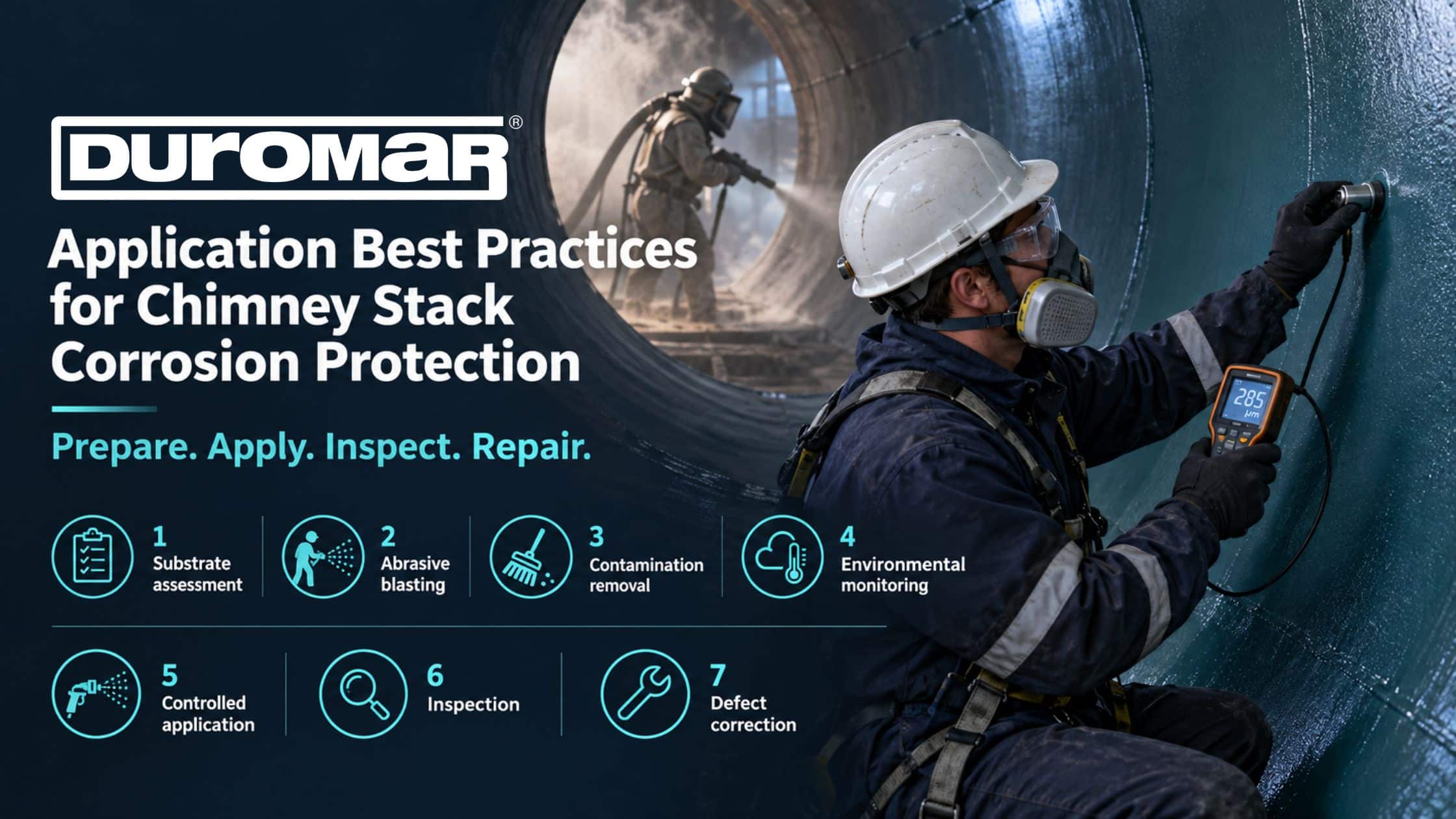
The performance of any epoxy coating depends significantly on how the lining is prepared, applied and inspected.
A technically controlled application should generally consider the following stages:
1. Substrate assessment:
Evaluate corrosion, pitting, existing coatings, welds, edges and areas of previous failure.
2. Abrasive blasting:
Prepare the substrate to the specified cleanliness standard and anchor profile required by the coating manufacturer and project specification.
3. Contamination removal:
Remove dust, salts, grease and other contaminants that could compromise adhesion.
4. Environmental monitoring:
Monitor substrate temperature, ambient temperature, relative humidity and dew-point conditions before and during application.
5. Controlled application:
Apply the epoxy novolac glass-flake system according to the specified mixing ratio, application procedure and film thickness.
6. Inspection:
Verify film thickness, continuity and visible defects. Particular attention should be given to welds, corners, edges, penetrations and previously corroded areas.
7. Defect correction:
Repair pinholes, holidays, damaged sections or areas outside the specified thickness before the equipment returns to service.
These controls are particularly important because an otherwise high-performance lining cannot compensate for poor surface preparation, incorrect application or inadequate curing.
Service Life and Inspection Considerations
There is no universal service-life figure that applies to every chimney lining. Actual durability depends on acid concentration, operating temperature, condensation frequency, thermal cycling, substrate condition, film thickness, surface preparation, mechanical damage and maintenance practices. Routine inspection should therefore look for:
- Cracking or delamination
- Blistering
- Pinholes or holidays
- Localised mechanical damage
- Exposed substrate
- Corrosion staining
- Areas of persistent condensation
- Deterioration around welds and edges
- Changes in coating thickness or continuity
For plants where access to the chimney requires significant shutdown planning, inspection should be incorporated into the broader asset-integrity programme rather than performed only after visible corrosion appears.
Supporting Chimney Corrosion Protection with Arudra
For power plants, refineries and process industries dealing with aggressive flue-gas environments, selecting the right lining requires consideration of chemical exposure, temperature, substrate condition, permeation resistance and application controls.
Arudra offers Duromar® HPL-4323 epoxy novolac glass-flake system specifically intended for chimney stacks, flue-gas ducts and other demanding applications. We identify chemical resistance, thermal flexibility, adhesion, rapid application and repairability among the system’s key characteristics.
We are based in Chennai and state that we operate as an ISO 9001:2015, ISO 45001:2018 and ISO 14001:2015 certified company. A properly selected and applied chimney glass flake lining can help establish a durable barrier between aggressive condensate and the underlying substrate.
Final Words
Chimney corrosion is driven by a combination of chemistry, moisture and temperature. When flue gases cool toward dew-point conditions, acidic condensates can attack metal surfaces and, if a coating system allows significant permeation, corrosive species can progressively move toward the substrate.
For industrial facilities where corrosion-related shutdowns and substrate deterioration are major concerns, the lining system should be selected according to the actual chemical, thermal and mechanical conditions of the asset. A properly specified and applied glass-flake epoxy lining can help reduce permeation and protect the underlying substrate from aggressive condensates.
Protect Your Chimney From Dew-Point Corrosion. Explore suitable glass flake epoxy lining options with Arudra Engineers for your application.


